
Jefferson County Release Date Labels
Florida records use several date labels, and none should be swapped casually. A current FDC Inmate Population detail displays Current Release Date. That is an anticipated date for a person who remains in state prison. Florida Statutes § 944.275 calls the gain-time-based projection a tentative release date. An FDC release or incarceration-history record instead shows Release Date and Date Out-Custody. Those past-event fields offer stronger proof that an FDC custody period ended.
The maximum sentence expiration date is another distinct measure. It reflects the endpoint of the imposed term as adjusted under the governing law. It is not always the day a person leaves. Lawful credits, another sentence, escape time, a parole violation, and a court correction can affect the computation. At Jefferson County Jail, an actual departure time belongs in the jail release or transfer record. A court order may supply authority, but a hold can delay physical departure.
- Current Release Date
- FDC's exact public label for the anticipated date on a current population detail.
- Tentative release date
- The statutory projection affected by gain-time granted, restored, or forfeited.
- Date Out-Custody
- The historical field showing when an FDC custody episode ended.
- Detainer
- A request or legal hold that may send a person to another custodian instead of the community.
Find Jefferson County Release Dates
The correct lookup begins with custody type. Jefferson Correctional Institution is an FDC state prison, even though it is in Monticello. Its inmates belong in the statewide corrections databases. Jefferson County Jail is a sheriff-operated local jail. FDC expressly excludes jail-only sentences, county probation, and other local dispositions from its public offender database scope. Searching the wrong system can produce no result or a record from a different custody episode.
- Identify whether the person is in Jefferson County Jail, an FDC prison, federal custody, or another agency. A transfer out is not always release to the community.
- For current FDC custody, open the Inmate Population Search. Use a DC number where possible, then confirm identity and read Current Release Date.
- For an FDC release that may already have occurred, use the Release Information Search and read the Release Date and Date Out-Custody fields.
- For a Jefferson County Jail sentence, ask JCSO for the maintained sentence computation and actual release or transfer record. Compare it with the Jefferson court judgment and jail-credit terms.
- If the person is awaiting trial, read the docket for bond and release orders, then confirm departure with the jail. Do not manufacture a date from a bond hearing.
The official FDC population detail shows the exact Current Release Date label.
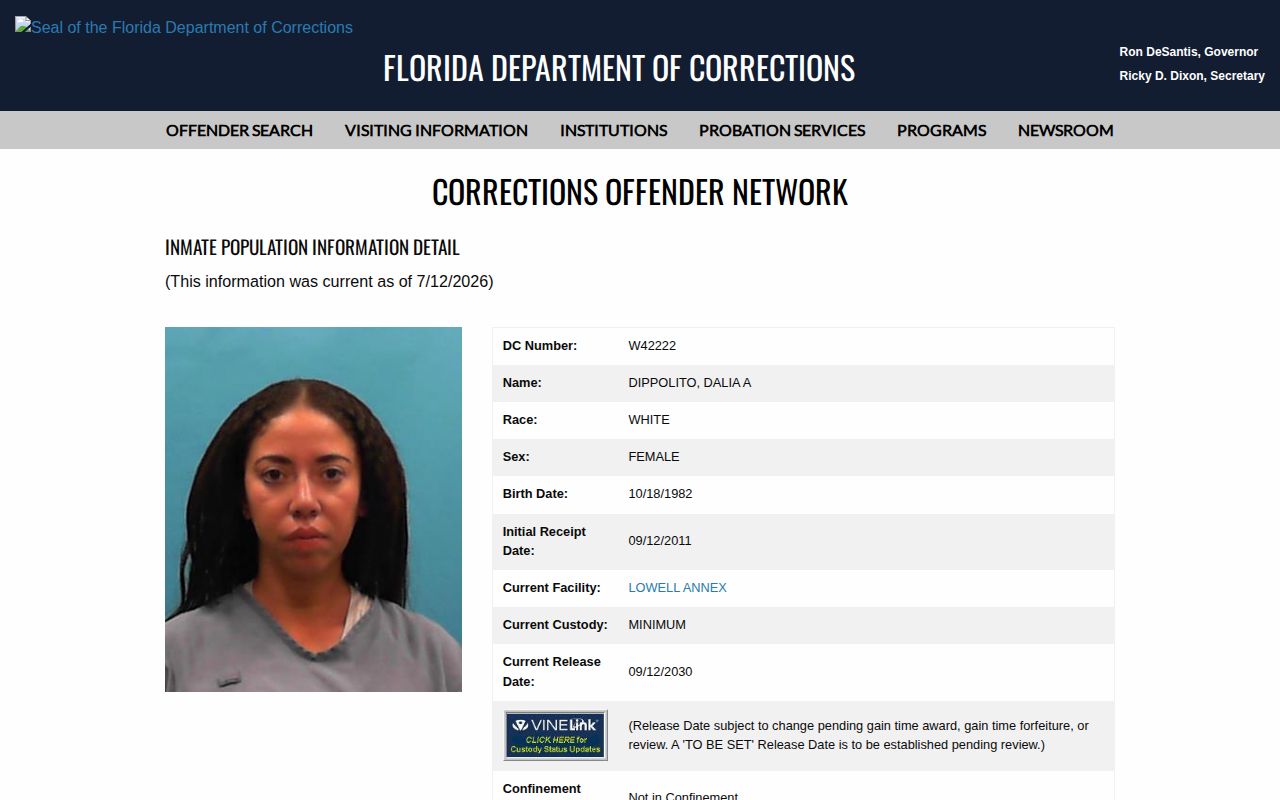
That label describes the FDC projection displayed at that point in time, not proof of departure from Jefferson Correctional Institution.
For local records, JCSO's custodian can be reached by mail, in person, telephone, or email. The verified office is at 171 Industrial Park, Monticello, FL 32344, with records hours of 8:00 a.m. to 4:00 p.m. Monday through Friday, excluding holidays. The telephone is (850) 997-2523. Ask for the existing computation and release or transfer record, not for staff to predict a date.
Note: A missing jail-roster name never proves community release because transfer to FDC or another custodian also ends local custody.
Jefferson County State Release Credits
For a Florida state prisoner, Florida Statutes § 944.275 directs FDC to establish both a maximum sentence expiration date and a tentative release date. Gain-time can move the tentative date. Credits that are restored may advance it, while forfeited credits may delay it. For qualifying offenses committed on or after October 1, 1995, incentive gain-time may reach up to ten days per month. Offense-date rules and exclusions still control.
Basic gain-time is not a modern award for all inmates. The statute limits that older category to offenses committed from July 1, 1978 through December 31, 1993. For the covered population under § 944.275(4)(b)3, credits cannot produce release before service of at least 85 percent of the imposed sentence. Court-awarded credit for time physically held counts toward that floor. Section 921.002 reinforces the Criminal Punishment Code principle.
A simple sentence multiplied by 85 percent is not an official release-date calculation. It can miss jail credit, concurrent or consecutive terms, offense-specific exclusions, forfeitures, restored credit, added sentences, and later court orders. FDC is the source for its own computation. A future date can change after the public page is read.
The Legislature's official section 944.275 display documents the state framework.
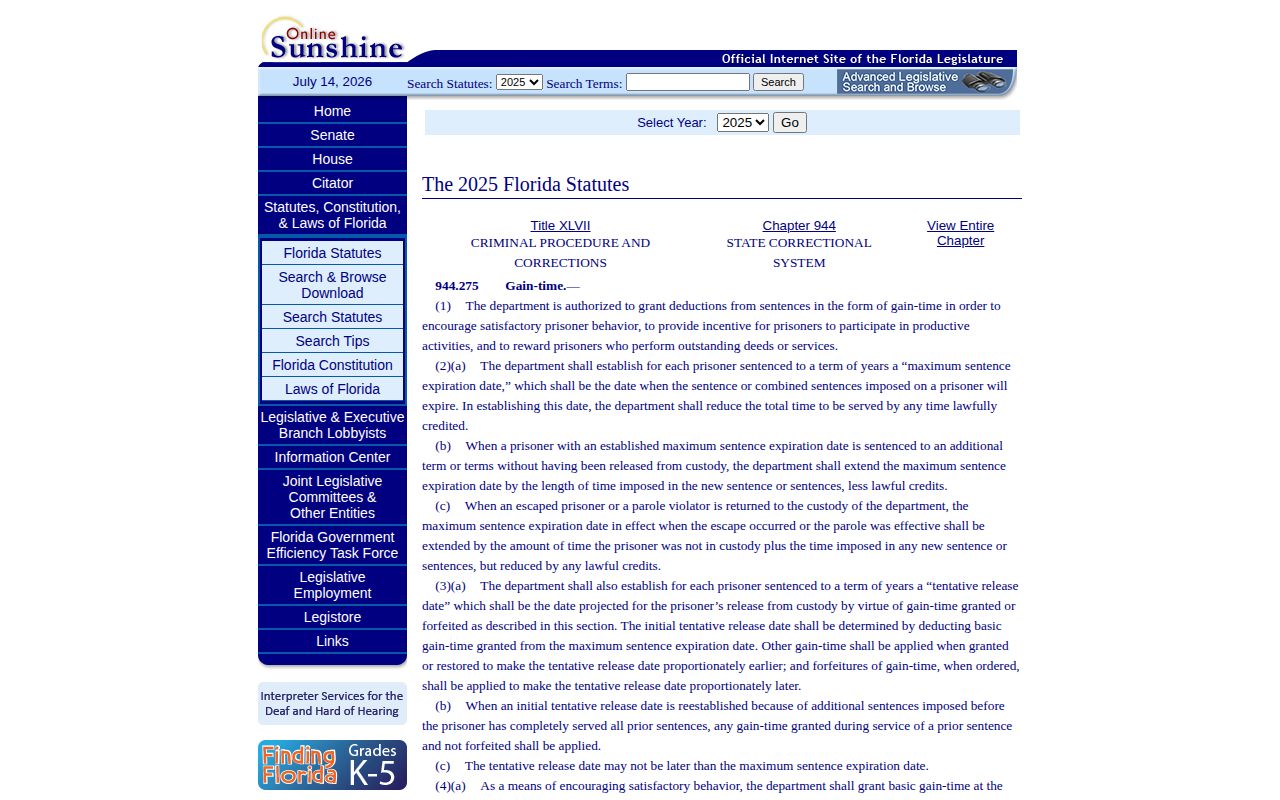
The statutory language explains the calculation rules, while the individual FDC record supplies the operative date for a named prisoner.
Jefferson County Jail Release Credits
County jail computation follows a separate law. Florida Statutes § 951.21 permits a locally revisable good-conduct schedule unless the county commission changes or ends that policy. The statute describes up to five days per month in the first and second years, ten per month in the third and fourth years, and fifteen per month in later years. It also permits an authorized meritorious allowance of no more than five days per month. Credits may be forfeited.
No Jefferson County resolution or jail policy was found that confirms use of the statutory maximum schedule. That gap is decisive. Do not apply the numbers to a person's jail term as if they were promised credits. Request the jail's maintained sentence calculation and compare it with the court judgment, sentence length, and credited time. FDC's state-prison 85 percent rule and Current Release Date field do not govern a jail-only sentence.
No authoritative Jefferson rule was located for moving a weekend or holiday expiration to Friday. JCSO also publishes no release-processing schedule. A calendar guess can be wrong when a hold, court correction, or local computation controls. Jail Operations or the records custodian must confirm the maintained date.
Jefferson County Release Date Changes
A projected date is a living computation until the custodial event occurs. Some changes affect the sentence itself. Others change only where the person goes after one term ends. A detainer may mean that a person leaves Jefferson custody on the stated date but enters another agency's control. That is an actual transfer, not an ordinary community release.
| Cause | Possible effect | Controlling record |
|---|---|---|
| Gain-time awarded or restored | Can move a tentative date earlier | FDC computation and current detail |
| Gain-time forfeited | Can move it later | Discipline and computation record |
| Added or corrected sentence | Can extend or recalculate the term | Court judgment and custodian calculation |
| Jail credit corrected | Can alter time left to serve | Court order and FDC or jail computation |
| Concurrent or consecutive terms | Changes the total time | Judgment and sentence computation |
| FCOR decision | Can change the release mechanism and supervision | FCOR decision and FDC record |
| Detainer or transfer | May prevent departure to the community | Release or transfer record and receiving locator |
| New case or violation warrant | May create another custody episode | Court, absconder, and booking records |
Read the dates in sequence. The judgment supplies the sentence. The custodian computes the projected end. A later order may alter that result. Finally, the release or transfer record shows what occurred. Combining unrelated cases or ignoring the receiving agency can create a false conclusion.
Note: Parole eligibility is limited in modern Florida and should never be assumed merely because an FDC record shows a future date.
Jefferson County Release Date Contacts
Use a specialized corrections contact when the public FDC date is unclear. The search menu lists the Bureau of Admission and Release at (850) 488-9167 and dc.release@fdc.myflorida.com for release-search questions. It lists Central Records at (850) 488-9859 and central.classification@fdc.myflorida.com for population and classification issues. Those offices are better placed than Jefferson County Jail to explain a state sentence computation. A formal request for maintained FDC documents can also go through the FDC Public Records page.
For a county sentence, request records from both sides of the calculation. The Jefferson Clerk can provide the judgment, sentence, jail-credit provision, and any later correcting order that exists in the case. JCSO can provide the jail's maintained computation and the actual release or transfer record. The court determines the legal term. The jail records when its custody ended. A difference between the two may reflect a hold, corrected credit, later order, or transfer that needs to be traced by date.
State the exact field in dispute. For example, ask FDC whether a displayed Current Release Date is still operative, or ask JCSO for the calculation supporting a stated county-jail expiration. Include the DC number or local booking number and a narrow date range. Neither office must create a new calculation in a format it does not maintain. Asking for the existing computation and source documents produces a record that can be checked against the judgment.
Confirm Jefferson County Release Dates
For a pending event, automated notification can supplement direct checks. Florida VINE may report a custody change for a participating Jefferson County or FDC record. Alerts can lag or fail, and a release notice may not name a receiving custodian. The Jefferson County VINELink release check explains how to search the correct agency entry and register for notice.
After the expected date passes, check the record built for completed events. Use FDC Release Information for a state prisoner and request the JCSO release or transfer record for a county detainee. If a court order is central, compare the Jefferson docket with the actual departure record. The Jefferson County released inmate records path joins those sources when a person has dropped off the live jail view.
A direct request should identify the person, booking or DC number, and relevant date range. Ask for the release date, release time, release reason or mechanism, and destination or receiving agency shown in the existing record. That approach confirms facts without asking an office to create a prediction.